Warming Up

Warming Up
Showing posts with label exercises. Show all posts

Wednesday, January 19, 2011

Practicing: Schlossberg

One of the trumpet method books I’ve had the longest is still one of my favorites:  Max Schlossberg’s “Daily Drills and Technical Studies.” 

Schlossberg was educated in Russia but came to the US around the turn of the 20th century.  He played for the New York Philharmonic but he is best remembered as maybe the first great “American” trumpet teacher.  His students were a who’s who of the (mostly classical) trumpet world.  And then many of his students became legendary teachers too.  I’m certainly partial to this book, maybe because I got it from my trumpet teacher, Frank Eisenreich (Pittsburgh – more on Mr. E in a future post) about 20 years ago.  I think I also really like this book because it works.  Whenever I’ve had time off of the horn for whatever reason, illness, kids being born, vacation, etc., I know that a few days spent with Mr. Schlossberg will always get me back to where I need to be. 

When I was a kid I really only played the slurs in the beginning of the book.  They are great slurs, for sure, but I think that I was missing the point of the book.  Schlossberg divided the book into sections and practicing a few exercises in each of these sections is the true key to getting the most out of this book.  In fact, on days when there is just isn’t much time to practice that much, or for those days when you have a long hard gig ahead of you, playing 30 -45 minutes of smart practicing (plenty of rest in between exercises) out of the Schlossberg book can cover almost all the bases you need.  It really is a great method.  You just need to know what you need to work on and you need to use some common sense so you don’t overextend yourself (especially if you are trying to get back into shape – pacing is key so you don’t tear down the tissue you are trying to build up). 
Here’s an example routine of how you could break this book down:

Section I: Long Note Drills
(he says long note yet most of these are slurs.  I think the idea is to play “through” the notes, keep the air moving as if it was one long note)


#2
#15


#27

#34


Section II: Intervals

#40
#42


Section III: Octave Drills
#49


#53


Section IV: Lip Drills
#59 and #60

Section V: Chord Studies

#70 (can be played tongued or w/slur combinations)

#76

Section VI: Scales
#90 and #91 (for #91 proceed down in half steps to low F#)


#99 (you can also use minor scales)


Section VII: Chromatic Scales
 
#119


#121


Section VIII: Etudes

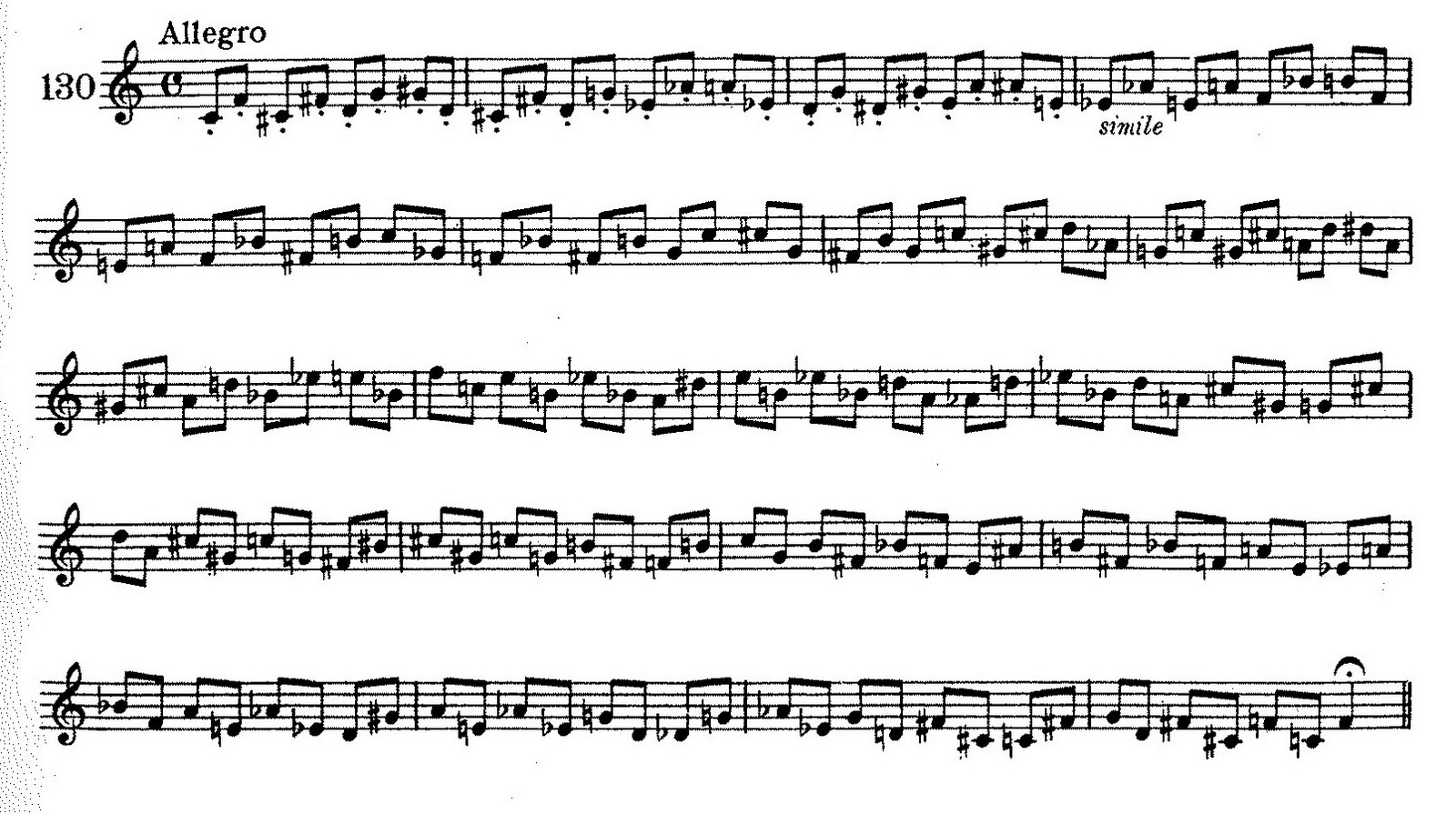
#130


(I like this one, #130. Plus it’s pitched fairly low and at this point I’m getting tired.  Play it tongued [single, K, double] or slurred in different combinations).

So you can see that this book really does cover all the bases of trumpet playing.  I’m not a high note guy at all, but this book has exercises that go higher than the ones I normally choose; and, like any other book, you can always extrapolate higher and higher if you are so inclined (and gifted). 

If you play trumpet then you probably already have this Schlossberg book in your library, but maybe check out using it this way - as maintenance when you don't have much time; or as a quick way to get back in shape.  If you don’t have it, then you need to get it :)  It’s a pretty special text.

Thanks for Caring, Thanks for Sharing.

P.S. - Wanna get real nerdy with some Schlossberg and a little Schlossberg drama? http://www.trumpetguild.org/pdf/2009journal/200906SchlossbergOnline.pdf

Thursday, January 6, 2011

Practicing


This post below will be the first in an ongoing series of blog posts about practicing. Sometimes I’ll post about specific things I’m working on or I might post about something I’ve heard about or found online.  Hopefully you might find some of this material useful and/or interesting…..

Shortly after my family and I moved to Glenside from Germantown (just outside the city from a neighborhood in the city) I discovered, to my good fortune, that a neighbor is a trumpet player.  Merv Gratz just turned 70 this past New Year’s Eve. Merv and I get together sometimes to hang and play duets and talk music.  He’s a good player, a good guy, and he knows a lot about the trumpet and the many great players and teachers from over the years.  He’s a guy who knows just what you are talking about if you mention Conrad Gozzo or Herbert Clarke or Charlie Shavers or Laurie Frink. Merv also seems to have every trumpet method/etude/studies book ever written.  A couple weeks ago, Merv dropped off about five books at my house – just some stuff for me to check out.  A couple were pretty standard method books – nothing new, nothing that isn’t already in Arbans or Schlossberg.  One was an interesting text on embouchures and various schools of thought on trumpet playing.  And the last one in the stack was a book by a guy named Bobby Shew and the book is called “Exercises and Etudes.”  Shew is a rare kind of trumpet player who really can play anything well – good jazz improvisation, strong lead playing, strong section playing, accomplished commercial player, and probably a good classical player too (although I haven’t heard him play in that style).  He’s been around since the sixties when I first heard his playing in Buddy Rich’s big band.  Shew is also an educator and clinician.  He’s not really the first guy I think of when I think of jazz trumpet players, but the guy can really play his ass off and given his success and longevity, I assume that he is also a great teacher.  So when Merv lent me Shew’s book I was kinda curious as to what the book had to offer.  The book is a mixture of studies (mostly scalar or interval based) and etudes.  It’s a solid book.  After checking it out a few times there are a few exercises that I’ve found that appeal to me and what I feel like I want to work on at this point in my playing.  So here is one of the exercises that I enjoy working through:


The way I have been approaching this exercise depends on what I want to accomplish in the particular practice session that I am playing this exercise in.  I usually try to mix up my sessions.  The first session of the day includes a warm up – long quiet tones, some lip bends, working into some slurs and gradually reaching for the top and bottom of my range.  Then maybe some scales or arpeggios tongued and slurred to get the tongue and fingers working in time.  I can use this Shew exercise at the end of this session or I can save the exercise for my next session which might focus more on tonguing and some other exercises or music that I want to work on.  For this Shew exercise I like to play through it slurred first.  Then single tongued.  Then if I feel like it (and I usually need it) I play through it with just a “K” tongue and/or double tongued.  Then I’ll put in some slurs in different combinations.  Then I’ll play it in triplets.  I also try to play some real quiet and others real loud.  It’s a pretty simple exercise but I can spend twenty minutes on this and get a lot out of it.  I’m working for speed and evenness too so it really can cover a lot of ground. 

As for applying this to some sort of jazz language, you can imagine that each line or phrase is reaching for a target note – for example in the first phrase the target note is a D.  If the target note is the I of a ii-V7-I then the line working up can be played as the ii-V7 or just the V7.  It works but the line does sound a bit weird over the ii-V7 chords.  Even better though, if you make the target note the V of the I then this line totally works.  Ex. In the first phrase D is the target note.  D is the V of a Gma7 chord.  So the ii-V7-I here would be Ami-D7-Gma7.  Check out the notes of the phrase now.  They totally work in a diminished/tritone sub kind of way. 
I’m not sure if Shew really intended this exercise to be picked apart and reworked like this, but who cares.  I think it’s more fun and more beneficial sometimes to make something of your own out of certain exercises.  Hope you enjoy.

Hey Merv - Thanks for Caring, Thanks for Sharing.